Pages

Friday, 13 January 2017

Types of Thermometer

There are several types of thermometer, here, I explain only a few of the possibly many types of thermometer.

Mercury thermometer


1. The physical quantity that is used to determine the temperature of a body by means of a mercury thermometer is the length of the thread mercury, or to be more exact, the volume of mercury.

2. When the temperature increases, the volume of the mercury increases too.

3. The sensitivity of a mercury thermometer can be increased by

a. reducing the diameter of the capillary tube.
b. increasing the size of the bulb.
c. using a thinner-walled glass bulb.

4. Normally mercury is used in a thermometer because it:

a. Expands uniformly.
b. has a higher boiling limit.
c. is opaque and therefore it is easier to read off the temperature.
d. is a good conductor of heat.
e. does not stick to the glass.

5. One weakness of the mercury thermometer in the measurement of an accurate temperature is that the glass of the capillary tube also expands when the temperature expands.

In addition to that, it is extremely dangerous if the glass tube breaks because mercury is very poisonous.

Mercury thermometer is suitable to measure temperature between -30 degree celsius to 300 degree celcius.

Resistance thermometer


1. Thermometers which use liquids inside the glass are not suitable to be used for measuring a wide range of temperature. e.g temperature ranging from -250 degree celcius to about 700 degree celsius.

2. A suitable thermometer which is used for the above range of temperatures is a resistance thermometer.

3. A resistance thermometer uses the property of the change in the platinum wire with a change in temperature.

4. The current flowing in the wire experiences more resistance when the wire becomes hot.

5. The change in the resistance of the wire is directly proportional to the change in temperature.

6. A milliammeter can and should be calibrated before hand to measure the temperature.

7. Its calibration of the melting limit of water and the boiling point of water at a pressure of 1 atmosphere is able to convert the milliameter scale to a temperature scale in degree celsius.

8. Therefore, this thermometer is very accurate.


Thermocouple thermometer


1. An electromotive force (e.m.f) will be produced in a thermocouple when there is a temperature difference between the hot junction and the cold junction. Once this happens, a current will flow.

2. This thermometer is very sensitive and responds towards slight change in temperature.

3. Since the physical quantity which is used to measure the temperature is the e.m.f, this thermometer can be connected to other electrical circuits to control or record the surrounding temperature.

4. A thermocouple thermometer is a very sensitive thermometer which is suitable for measuring temperatures ranging from -250 degree celsius to 1600 degree celsius.
Read More »

Understanding Thermal equilibrium

It has to be noted that temperature is one of the basic quantities in physics.

Temperature is a physical quantity which measures the DEGREE of HOTNESS of an object. So as you probably have inferred, hot object has a higher temperature than a cold object.

The SI unit of temperature is Kelvin, K. Other units such as degree Celcius (centigrade) and Fahrenheit is also used.

When two objects are in thermal contact, heat is transferred from one object to the other.

The temperature of the objects determines the direction of energy transfer between them. The energy transferred between objects in thermal contact is known as heat.

Let say there are two objects A and B.

Say A has higher temperature than B. When A and B is in contact with each other, heat will be transferred from A to B. That is A will give heat and B will receive heat. When this situation occurs, it is called net heat transfer from A to B.

The heat transfer will continue until a state of thermal equilibrium is achieved.

It is expected that temperature of B will rise to a certain degree (due to increased kinetic energy in the molecules), when thermal equilibrium is achieved and temperature A will fall. At the end of transfer, both A and B will have the same temperature.

Heat

Heat is a form of energy. The SI unit for heat is joule, J.

Heat is produced by mechanical energy or from the conversion of other types of energy. such as electrical energy to heat energy and so on.

It must be noted that Temperature is NOT the same as Heat.

Temperature is a measure of degree of hotness of an object, is a base quantity, SI unit is kelvin and other units are degree celcius and fahrenheit. It determines the direction of heat flow.

Heat is a form of energy, is a derived quantity and SI unit is Joule, J. (other unit is calorie, cal.) It is being transferred from a region of higher temperature to another region of lower temperature.

Hope this does not confuse you!
Read More »

Bernoulli's Principle as Applied to Fluid Flow in Tubes

When a fluid passes through a tube which, narrows or widens along its length, the velocity of the fluid varies. As the tube narrows, the fluid flows faster and, correspondingly, pressure in the narrow section decreases.

As can be seen on the diagram, water is flowing from d1 to d2 to d3.

The water has the highest level at d1 and d3 because the diameter of the tube is narrower at d2. (note that the diameter of d1 = d3). Theoretically, the water level in d3 will be slightly lower than that of d1 because the flow of water won't be as fast as in d1. (remember, the water now is coming form d2) but as for a generalization, I think it is ok to emulate understanding in minds of pupils.


Animation of this can be seen here

http://www.openteach.com/javaapplets/Bernoulli.html
The same can be seen if we are using the flow of air.

Where the region of swiftest air flow will have a region of lowest pressure.
Read More »

Applications of Bernoulli's Principle

1. Aerofoil

The flight of an aeroplane is based on the principle regarding to the effect of the flow of air around its wings, which is, the aerofoil.

An aerofoil shape has a rounded front edge and pointed (sharp) trailing edge. The top surface is arched (curved) and the bottom is flat.

When a wing in the form of aerofoil moves through air, the flow of the air over the top has to travel faster to cover the longer distance (compares to the lower portion) and creates a region of low pressure. The flow of air below the wing is slower resulting in a region of higher pressure.

The difference between the pressures at the top and the bottom creates a NET UPWARD FORCE..(remember! bottom part higher pressure..upper part lower pressure).This is called a Lift and helps the plane to take off.

In addition to that, inverted aerofoils are used in racing cars to create a donward force and stabilize the cars at high speed.

2. Bunsen Burner

When a bunsen burner is connected to a gas supply, the gas flows at high velocity through a narrow passage in the burner, creating a region of low pressure.

The outside air, which is at atmospheric pressure, is drawn in an mixes with the gas.

The mixture of gas and air enables the gas to burn completely to produce a clean, hot fire.

Other applications that you must read on your own.

- Hydrofoil Boat
- Insecticide Spray (or whatever sprays that available)
- The shape of canvas roof ( in car) when its moving - why the roof bulges upward?
- Carburettor
- Curve Ball Spin offs
- The shape of a ski-jumper's body when he's jumping..its curved right? Why?

All the best!!
Read More »

Understanding Bernoulli's Principle

Have you ever thought why birds can fly so efficiently in the air?
or likewise the plane?

that movement or phenomenon can be explained by Bernoulli's Principle.

Bernoulli's Principle states that as the speed of a moving fluid increases, the pressure within the fluid decreases.
Therefore, the pressure in a moving fluids depends on its flow velocity (remember fluids =  water, air)

A full definition of Bernoulli's Principle is:

IN a steady flow of a fluid, the pressure of the fluid decreases when the velocity of the fluid increases.

Bernoulli's principle is very important as it is used in the design of airplanes, boat hulls, fan blades and cars.

Example of situations that involves Bernoulli' s Principle:

Ping Pong Balls and Funnels

An inverted filter funnel can hold a ping pong ball if you blow air through the funnel, it does not drop down. Thats because the air flows around the ping pong ball at high speed and creating  a low-pressured area, the higher atmospheric pressure supports the ball from falling.


Curve Balls in Baseball

Now lets move on from ping pong to baseball. A pitcher occasionally tries to fool the batter into a strike by throwing a curve ball. It seems to be heading straight into the strike zone but veers off at the last minute. STRIKE! How do they do that?

OK, you can try this at home.

Try blowing through two pieces of paper. Separate the papers slightly so you can blow air through it. Instead of the paper being separated it will get nearer to each other. That's because the faster air flow in the middle of the papers creating a lower-pressure region and the higher atmospheric pressure pushes the paper so it gets nearer to each other.

There are more situations of Bernoulli's principle in daily life if you dare to think and spend a little time observing.
Read More »

Application of Archimedes' Principle

Hello guys, these are only a few examples of the application of Archimedes' Principle. This examples only serve as a guidance and you should try to search for other examples. :) Hope this helps.

1. Submarine:

A submarine has a large ballast tank, which is used to control its position and depth from the surface of the sea.


A submarine submerges by letting water into the ballast tank so that its weight becomes greater than the buoyant force.

Conversely, it floats by reducing water in the ballast tank.-thus its weight is less than the buoyant force

2. Hot-air balloon

The atmosphere is filled with air that exerts buoyant force on any object.


A hot air balloon rises and floats due to the buoyant force (when the surrounding air is greater than its weight). It descends when the balloon's weight is higher than the buoyant force. It becomes stationary when the weight equals the buoyant force.

The weight of the Hot-air balloon can be controlled by varying the quantity of hot air in the balloon.

3. Hydrometer

A hydrometer is an instrument to measure the relative density of liquids.


It consists of a tube with a bulb at one end. Lead shots are placed in the bulb to weigh it down and enable the hydrometer to float vertically in the liquid.


In a liquid of lesser density, a greater volume of liquid must be displaced for the buoyant force to equal to the weight of the hydrometer so it sinks lower.

Hydrometer floats higher in a liquid of higher density.

Density is measured in the unit of g cm-3.


4. Ship


A ship floats on the surface of the sea because the volume of water displaced by the ship is enough to have a weight equal to the weight of the ship.

A ship is constructed in a way so that the shape is hollow, to make the overall density of the ship lesser than the sea water. Therefore, the buoyant force acting on the ship is large enough to support its weight.

The density of sea water varies with location. The PLIMSOLL LINE marked on the body of the ship acts as a guideline to ensure that the ship is loaded within the safety limit.

A ship submerge lower in fresh water as fresh water density is lesser than sea water. Ships will float higher in cold water as cold water has a relatively higher density than warm water.


5. Fishes

Certain group of fishes uses Archimedes’ principles to go up and down the water.

To go up to the surface, the fishes will fill its swim bladder (air sacs) with gases (clever isn't it?).

The gases diffuse from its own body to the bladder and thus making its body lighter. This enables the fishes to go up.

To go down, the fishes will empty their bladder, this increases its density and therefore the fish will sink.

6. FLIP – Floating instrument platform.
This is a research ship that does research on waves in deep water. It can turn horizontally or vertically. When water is pumped into stern tanks, the ship will flip vertically.

The principle that is used in FLIP is almost similar with the submarines. Both ships pump water in or out of tank to rise or sink.
Read More »

Applying Archimedes' Principle

Steel is denser than water. However they still float, why?

Have you ever wondered why hot air balloon floats in the air? Even though the mass of the balloon is big?

Archimedes (287-212 B.C.) was a greek scientist who first discovered that

"an object submerged in a liquid is acted on by an upward buoyant force (or upthrust)."

The buoyant force is due to the surrounding liquid which causes the object to weigh less in the liquid. Archimedes realised that submerged objects always displace liquid upwards, (when you put an ice to a glass of water, the water level rise). Later he did show that the upthrust is equal to the weight of water displaced.

Archimedes' principle states that an object, whether completely or partially immersed in a fluid, is acted on by a buoyant force, which is equal to the weight of the fluid displaced.
Read More »

Buoyant Force and Flotation

What Causes Buoyant Force?


The difference between the forces acting on the UPPER surface and the LOWER surface is the net force acting UPWARDS.

This net force is known as the BUOYANT FORCE. (Remember! Pressure = Force / Area). If you rearrange the Force to become the subject F = P x A.

Pressure, P = hpg (h = height, p = density, g = gravitational force)

Say, 
Force acting on the upper surface, F1 = P1 A
                                                        = h1pg A

Force Acting Underside, F2 = P2 A
                                          = h2pg A

Net Force Acting Upwards = F2 - F1
                                         = Buoyant Force
                                         = Weight of Liquid Displaced = mg


h1 is the distance from the TOP area of the object to the surface

P1 is pressure 1

p is density of liquid

g is gravity value

A is the total surface area.


h2 is distance from surface to BOTTOM part of the object

P2 is pressure exerted on the lower side

Therefore, the buoyant force is equal to the weight of liquid displaced, which is in accordance with Archimedes' Principle as I will explain here.


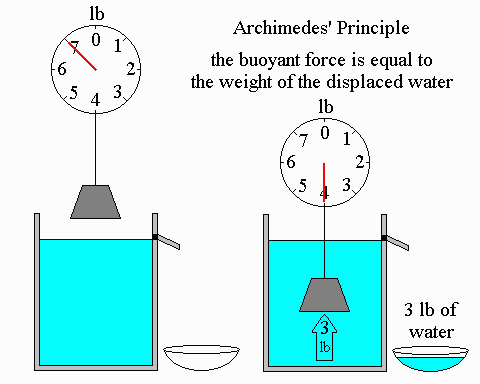
In the above figure, the object is lowered into the water, the following observations are made.

i) The object experiences a reduction in weight. The object of the weight in water is less than its weight in air. The apparent loss in weight of the obejct is caused by the buoyant force of the surrounding water 
on the object.

Apparent loss in weight of object
=Weight of object - weight of object in water.

ii) The object displaces a vlume of water.
Volume of water displaced
= volume of the submerged part of the stone

iii) From the figure, the apparent loss in weight is due to the buoyant force.

Therefore :
Bouyant Force = Actual weight - weight in water
= (Say) 70N - 40 N
= 30 N  

Read More »

Law of Flotation

Have you ever wondered what causes things to float on water or liquid?

Well, floating is caused by an upthrust force that act on the material and interestingly there's a LAW that governs whether an object floats or not it is called the LAW of Flotation.

"Law of flotation is an application of Archimedes' principle"

When a piece of wood of density more than water is placed on water, it sinks and displaces some water.

As it sinks, more and more water is displaced. This increases the buoyant force as the the buoyant force is equal to the weight of water displaced.

The wood will sink until the buoyant force equal its weight.

Therefore,

The law of flotation states that a floating object displaces its own weight of the fluid in which it floats.

i.e.

Weight of floating object= weight of fluid displaced

Mass of floating object = mass of fluid displaced

Any changes in the density of the surrounding liquid affects the level in which an object floats.

Thus, you have to remember that an object will DISPLACE the amount of water or liquid that is equal to its own mass in order to float.
Read More »

Basic Hydraulic System

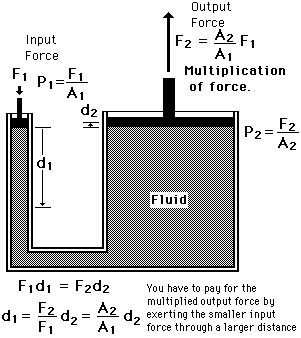
A hydraulic system operates based on Pascal's principle.

In this hydraulic system, a small force, F1 is applied to the small piston resulting in a large force , F2 at the piston K. The pressure, due to the force, F1, is transmitted by the liquid to the large piston.

Pressure, P = F1/A1

This pressure is transmitted through the liquid and acts on the base of the large piston.

Force on the large piston, F2 = P X A2.
= (F1/A1) X A2.

The large force causes the load to rise.

Also F2/F1 = A2/A1

Output force / input force = output piston area / input piston area

Because of the much larger surface area, A2 of the piston K compared to the surface area, A1 of the piston, the resultant force, F1.


This shows that a large force can be produced by a small force, using Pascal's principle.

Hydraulic systems act as a force multiplier where A2/A1 is the multiplying factor.

For example, if A2=5A1, then F2 = 5F1

since F2 = F1 X (A2/A1)

A hydraulic system must not contain any air bubbles in any portion of its hydraulic fluid system.

The presence of air bubbles in the hydraulic fluid system will reduce the efficiency of the system as part of the applied force will be used to compress the air bubbles.
Read More »