Pages

Friday, 13 January 2017

JAMB Registration & Requirements 2017/2018 (20 December 2016 – 9 February 2017)

JAMB Registration & Requirements 2017/2018 (20 December 2016 - 9 February 2017)
JAMB Registration & Requirements 2017/2018 (20 December 2016 – 9 February 2017)
JAMB Registration form for 2017/2018 Computer Based Test (CBT) is out online at jamb.org.ng. The guidelines, requirements and details of the registration process has been outlined below.
All candidates seeking admission into Nigeria’s Federal, State and Private; Tertiary Institutions like Universities, Polytechnics and Colleges; or other specialized institutions are hereby notified to apply while registration is still on. The Unified Tertiary Matriculation Examination (UTME) Registration 2017 would last between 20th of December, 2016 – 9th of February, 2017.
JAMB Registration 2017 / 2018 Validity (Registration Starting and Closing Date)
The commencement of JAMB registration 2017 online for UTME Registration Begins 20th of December, 2016, and it is scheduled to End on 9th of February, 2017.
JAMB UTME Registration Fees For 2017
Candidates are expected to pay to register for JAMB UTME. The 2017/2018 registration fee is ₦6,500.
  • JAMB scratch Card = ₦5,000.
  • Online Registration = ₦1,000.
  • JAMB Handbook/Brochure = N500.
Note: Candidates are expected to purchase the textbook, titled The Last Days at Forcados High School which cost Five Hundred Naira (₦500.00) only.
How To Purchase Registration Forms and Scratch Cards
Registration forms and scratch cards are now available in the following Banks and NIPOST offices Nationwide.
  • Zenith Bank Plc.
  • Skye Bank Plc.
  • First Bank Plc.
Note: All candidates are to take note that irrespective of their choice of course of study or method of testing, they will also be tested on a general book. The name of the general book is; “The Last Days at Forcados High School.” by A. H. Mohammed.
Read More »

JAMB Guidelines & Requirements 2017/2018 For Computer Based Test (CBT) Centre

 JAMB Registration & Requirements 2017/2018 (20 December 2016 - 9 February 2017)
JAMB Guidelines & Requirements For 2017/2018 For Computer Based Test (CBT) Centre


The Joint Admissions and Matriculation Board (JAMB) has released new guidelines that would help to reduce and intend to totally remove the fraudulent practices in the examination system ahead of 2017/2018 Unified Tertiary Matriculation Examination (UTME).
JAMB Guidelines & Requirements For 2017/2018 For Computer Based Test (CBT) Centre
The guidelines should also be firmly held by both the existing and intending CBT Centre owners.
  • Minimum 15 inches flat screen Computer monitor for desktop or 17 inches for laptop.
  • The computer systems must be connected to a robust computer server with a capacity to carry 250 systems concurrently.
  • All the computer systems must be linked together on Cable Local Area Network topology (LAN). (Wireless Computer connection is not allowed).
  • Adequate security and minimum of five (5) technical personnel and one network engineer.
  • Availability of back-up power supply (power generating set of minimum 40kva for a centre with 250 systems; 60 kva for 350 systems and 100kva for above 350 systems) and UPS/ inverters that can carry all systems for a minimum of two (2) hours.
  • The centre must be adequately fenced.
  • Provision must be made for a holding room or reception facility e.g canopy with chairs, etc.
  • The centre must not be in shared premises such as cinema hall, shopping mall, market, etc.
  • Availability of adequate and functional air-conditioners and lighting.
  • Provision of up to date Antivirus and all the systems must be virus free.
  • Minimum of Windows 7 or higher version of windows operating system.
  • IP Camera (CCTV) is compulsory for all CBT centers (Specification to be given by JAMB).
Read More »

Analysing Electromagnetic Waves


1. Electromagnetic waves consist of vibration of magnetic field and electric field which are perpendicular to each other.

2. Therefore, Electromagnetic waves are transverse waves.

3. The velocity of electromagnetic waves in vacuum is 3 X 10 (8)(to the power of eight) meter per second.

4. Differences in wavelength between electromagnetic waves producer a spectrum of electromagnetic waves.

Electromagnetic waves sorted starting from High Frequency to the Lowest Frequenct

Gamma rays

X-Rays

Ultraviolet

Visible Light

Infrared

Micro Waves

Radio Waves


Hope you all have an idea :)
Read More »

Electromagnetic Spectrum

When you watch television, listen to the radio or cook something in a microwave oven , you are actually apply the properties of electromagnetic waves. Do you know what is an electromagnetic wave?

Electromagnetic waves are propagating waves that travel in space with both electric and magnetic components. These components oscillate at right angles to each other and to the direction of propagation.

Electromagnetic waves carry energy and momentum which may be given when they interact with matter.

Electromagnetic waves comprise of a series of waves whose frequencies and wavelengths extend over a broad range. Waves in the electromagnetic spectrum vary in size from very long radio waves to very short gamma rays.

Visible light waves are the only electromagnetic waves we can see. We see these waves as the colours of the rainbow. Each colour has a different wavelength. Red has the longest wavelength and violet has the shortest wavelength. When all the waves are seen together, they produce white light.

When white light shines through a prism or through water vapour, the white light is broken apart into the colours of the visible light spectrum.

The electromagnetic spectrum is the range of frequencies and wavelengths over which electromagnetic waves are propagated.

Sources of Electromagnetic Waves.

Matter is made up of elementary particles called atoms.

Every atom has a nucleus at its centre which is surrounded by orbiting electrons.

Electrons are negatively charged particles and they circle around the nucleus in orbits, each of which is at a specific energy level. When a charged electron travels from an orbit with a particular energy level to one of a lower energy level, electromagnetic waves are emitted.

Electromagnetic waves are also produced when a charged particle (electron or nucleus) oscillates.

Properties of electromagnetic waves

Electromagnetic waves are:

a. Transverse waves

b. Do not require a medium to propagate and can travel in a vacuum.

c. The magnetic and electric field components of the wave oscillate at right angles to each other and to the direction of propagation of the wave.

d. Obey the wave equation c = fλ. c is the velocity of light, f is the frequency of the wave and the λ is the wavelength.

e. In a vacuum , the waves travel at the speed of light c = 3 X 10^8 ms-1.

f. Undergo the same phenomena as light: reflection, refraction, diffraction and interference.

g. The waves are electrically neutral.

h. Show characteristics of polarization.

i. Energy is transferred by the waves.

In a vacuum, c is a constant for all elecgromagnetic waves The formula c = fλ shows that the frequency f is inversely proportional to the wavelength λ. (f = c/λ)

The velocities of an electromagnetic wave in other media are different from its velocity in vacuum.

Detrimental effects of electromagnetic spectrum.

The invisible waves or radiation that are emitted from power lines, cellular phones, radio antenna, could potentially be harmful to our health.

The detrimental effects of excessive exposure of the human body to electromagnetic waves of increasing frequencies:

a. Radio waves: harm body cells, prevalence of migraine, headache disorders.

b. Microwaves: internal heating of body tissue

c. Infrared: skin burns

d. Visible light: increased rates of premature skin aging and skin cancer

e. Ultraviolet: damage to surface cells (including skin cancer) and blindness.

f. X-rays: damage to cells.

g. Gamma rays: cancer, mutation
Read More »

Analysing Sound Waves

1. Sounds are mechanical waves. They are caused by vibrating objects. Hence, all vibrating objects produce sound. As an example: The strings of a guitar, the skin of a drum and a tuning fork vibrate to produce sound.


2. By using a loudspeaker as an example,  the vibrating cone of a loudspeaker produces sound by vibration.

3. Its vibrating diaphragm is continually compressing and stretching the air next to it.

4. This produces a series of compression and rarefaction travel through the air away from the loudspeaker.

5. Compression is a region of increased pressure and rarefaction is region of decreased pressure. The resulting succession of compression and rarefaction makes up the sound waves.


6. Sound wave is longitudinal in nature because the air molecules vibrate in a direction which is parallel to the direction of propagation is essentially due to the vibration of molecules of its medium.

7. Compression and rarefaction need a material which can be compressed and stretched. This explains why we do not hear any sound from the outer space which mainly consists of vacuum.

Amplitude and Frequency of Sound Waves

1. The amplitude of sound waves depends on its loudness. The louder the sound, the bigger is its amplitude.

2. The frequency of sound waves depends on its pitch. The higher the pitch of the sound, the higher is its frequency.

Applications of sound waves

1. Sound can be generated at a wide range of frequency.

2. Sound waves generated between 20 Hz and 20 kHz can be heard by normal human ears and are known as audio waves.

3. Those below 20 Hz are called infrasound and those above 20 kHz are known as ultrasound.

4. A bat can navigate in complete darkness by emitting very high-pitched sound waves in the ultrasonic range. When the waves hit a nearby object, they are reflected and received by the bat. The time lag between the emission of the sound waves and sensation of the reflected waves helps  the bat to estimate the position of the object accurately. The bat then adjust its direction to avoid knocking the object.

5. Dolphins use ultrasonic frequency of about 150 kHz for communication and navigation.

6. Ultrasonic rulers in ships use ultrasonic echoes to measure distance.

7. High intensity ultrasonic shockwaves can be used to break kidney stones.

8. Opticians and goldsmiths use ultrasonic cleaner to clean spectacles, jewellery and ornaments. The water used for the cleaning purpose is vibrated by ultrasound. The vibrations shake off dirt attached to these objects.

9. Dentists also use ultrasonic beams to vibrate and shake off dirt and plaque off the the teeth of patients.
Read More »

Speed of Sound, Loudness and Amplitude of Sound

Speed of Sound

1. The speed of sound,v, in a medium can be defined as v = fλ, where λ is the wavelength and f is the frequency. The SI units of v is ms-1, f is Hz and λ is  m (metre).

2. The speed of sound in solid is greater than in liquid, and the speed of sound in liquid is greater than in gas.

3. The speed of sound is unaffected by pressure. As an example, iIf the atmospheric pressure changes, the speed of sound in air remains constant.

4. The speed of sound increases with temperature. At the peak of high mountains, the speed of sound is less than that at sea level. This is not due to the lower pressures but because of the lower temperatures at the peak of mountains.

Loudness and amplitude of sound

1. The loudness of sound is considered to be high or low according to the hearing ability of a person.

2. Loudness is influenced by the amplitude of the sound wave.

3. Amplitude has several definitions.  Some of them are:

Amplitude is


  • a measurement from the lowest point that the wave hits to the highest point the wave hits.
  • a measurement of the top half of the wave.
  • a measurement of the distance between two nearest peaks or two nearest troughs.
  • a measurement of the bottom half of the wave.


Pitch and Frequency of Sound


1. The pitch of sound or a musical note is an indication of how high or how low the sound is. Is is a subjective judgement which varies with different individuals.

2. The pitch of a sound is determined by its frequency: a high pitch corresponds to a high frequency.

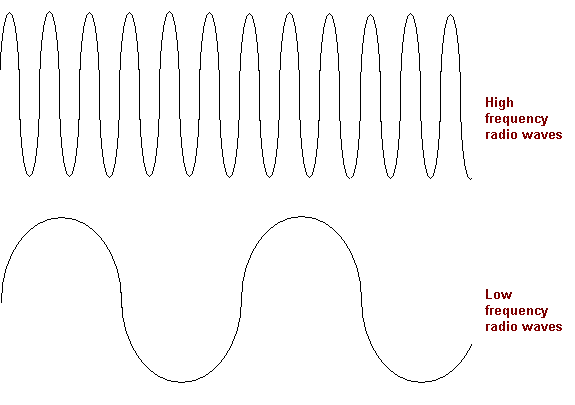
3. Frequency is how many oscillations a wave complete in a given period of time. Hence you can see that high frequency waves are thinner than low frequency waves because more oscillations are made in the high frequency waves as compared to the low frequency waves within the same period of time.
Read More »

Damping and Resonance of Waves

Displacement –time and Displacement –distance graphs.

Wave motion occurs because of the vibration of particles from their resting position.

We can show the displacement of particle (from its rest position) at different times by plotting a DISPLACEMENT-TIME graph.

We can show the displacements of particles of the wave at a certain time by plotting a DISPLACEMENT-DISTANCE graph.


The relationship between speed, wavelength and frequency.

Frequency (f)= Velocity (v) / Wavelength (λ)
v = f x λ

Damping in an oscillating system

Any motion that repeats itself in equal intervals of time is called a PERIODIC MOTION.

If a particle in a periodic motion moves back and forth over the same path, we call the motion OSCILLATORY or VIBRATORY.

Many of these oscillating bodies do not move back and forth between precise time fixed limits because frictional forces DISSIPATE the energy of the motion. Thus a pendulum stops swinging after some time.

The amplitude of oscillation of the simple pendulum will gradually decrease and become zero when the oscillation stops.

The decrease of in the amplitude of an oscillating system is called damping.

Two types of damping:
1. External damping: loss of energy to overcome frictional forces or air resistance.
2. Internal damping: loss of energy due to the extension and compression of the molecules in the system.

Damping in an oscillating system causes the amplitude and energy of the system to DECREASE but frequency DOES NOT change.


We CANNOT eliminate frictional force from the periodic motion of an object BUT we can cancel out its damping effect by feeding energy into the oscillating system so as to COMPENSATE for the energy dissipated by the frictional force.

For Example, the oscillating pendulum in a pendulum clock uses energy derived from the fall of a weight pulling a chain in the clock to supply external energy.

Resonance In An Oscillating System

When a system oscillates there is a loss of energy due to damping.
If the loss of energy is replaced by an external force of the same frequency, the system will continue to oscillate and may reach a bigger amplitude.

The external force supplies energy to a system, such a motion is called a forced oscillation.

Natural frequency is the frequency of a system which oscillates freely without the action of an external force.

RESONANCE occurs when a system is made to oscillate at a frequency EQUIVALENT at a frequency to its natural frequency by an external force. The resonating system oscillates at its MAXIMUM AMPLITUDE.

Here Resonance 1(R1) is more than Resonance 2 (R2)

The characteristics of resonance can be demonstrated with a Barton’s pendulum system.


Some effects of resonance observed in daily life:

The tuner in the radio or TV enables you to select programmes you are interested in .The circuit in the tuner is adjusted until resonance is achieved, at the frequency transmitted by a particular station selected. Hence a strong electrical signal produced.

The loudness of music produced by musical instruments such as the trumpet and flute is the result of resonance in the air.

The effect of resonance can also cause damage. For example, a bridge can collapse when the amplitude of its vibration increases as a result of resonance. aka when it vibrates at its natural frequency.
Read More »

Analysing Interference of Waves

Principle of Superposition

1. The principle of superposition states that at any instant or moment, the wave displacement of the combined motion of any number of interacting waves at a point is the sum of the displacements off all the component waves at that point.

2. a + a = 2a

a + -a = 0

-a + -a = -2a


Interference of Waves

1. Interference is the superposition of two waves originating from two coherent sources. Sources which are coherent produce waves of the same frequency,f, amplitude,a, and are in phase.

2. The superposition of two waves emitted from coherent sources gives either constructive or destructive interference.

3. Constructive interference occurs when the crests or throughs of both waves coincide to produce a wave with crests and troughs of maximum amplitude.


4. Destructive interference occurs when the crest of one wave coincides with the trough of the other wave, thus cancelling each other with the result that the resultant amplitude is zero.

5. An antinode is a point where a constructive interference occurs, whereas a node is a point where destructive interference occurs. The antinodal lines join all antinodes and the nodal line joins all nodes.

Relationship between lambda, a, x and D (will be discussed later)

Interference of Light waves

1. Waves emitted from two coherent sources have the same frequency,f or wavelength and in phase.


2. Light emitted by a single source of consists of waves which extend over a wide range of wavelengths and are not in phase. because of this, it is difficult to have two sources of light which are coherent.

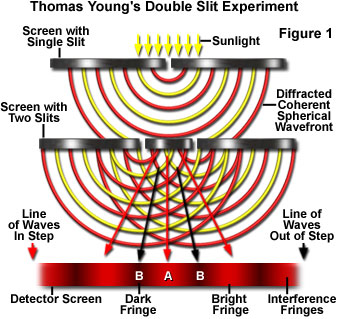
3. In 1801, Thomas Young produced two coherent light sources in his experiment now referred to as Young's double slit experiment.

a) Yellow light emitted by a sodium-vapour lamp has a very narrow frequency band. for all its practical purposes, it can be considered as a monochromatic light which is light of only one frequency or wavelength.

b) Slits s1 and s2 give rise to two coherent light sources since the light passing through them are from the same monochromatic light, the sodium vapour light.

c) Interference occurs as a result of the superposition of the two light waves originating from s1 and s2. A pattern consisting of a series of parallel and alternating bright and dark fringes is formed.

d) The bright fringes are the region where constructive interference occurs, whereas the dark fringes are regions of destructive interference.
Read More »

Analysing Diffraction of Waves

1. Diffraction of waves is a phenomenon in which waves spread out as they pass through an aperture or round a small obstacle.


2. The effect of diffraction is obvious only if

a) the size of the aperture or obstacle is small enough.
b) the wavelength is large enough

3 Characteristics of diffracted waves:

a) Frequency, wavelength and speed of waves do not change.
b) Changes in the direction of propagation and the pattern of the wave.

Diffraction of Light

1. Light is diffracted if it passes through a narrow slit comparable in size to its wavelength.
However, the effect is not obvious as the size of the slit increases. This because the wave-lengths of light are very short.

2. Diffraction of light is hardly noticeable compared with diffraction of sound waves and water waves because the wavelength of light is very short or small (approx: 10-7 m)

3. Light waves will be diffracted if

a) Light is propagated through a pin hole or a tiny slit where its size is similar to that of the light wavelength (around one hundredth of a millimetre or less)

b) the light source is monochromatic, i.e. light of one colour, and therefore one wavelength only.
Read More »

Analysing Refraction of Waves

Any type of wave can be refracted, refracted is a change in direction. Refraction occurs when the speed of a wave changes, as it moves from one medium to another.

Refraction of Plane Water Waves

1. Water waves undergo refraction (bending) when its speed changes. Refraction is accompanied by a change in speed and wavelength of the waves.


2. Water waves travel faster (with higher velocity, v) on the surface of deep water then they do on shallow water. Thus, if water waves are passing from deep into shallow water, they also will slow down. This decrease in speed will also be accompanied by a decrease in wavelength. The change of speed of the wave causes refraction.

3. After refraction, the wave has the same frequency,but a different speed, wavelength and direction.

4. When a water wave travels from deep water into shallow water, the wave is refracted towards normal. Conversely, the wave is refracted away from the normal when the water wave travels from shallow water into deep water.

Refraction of Light

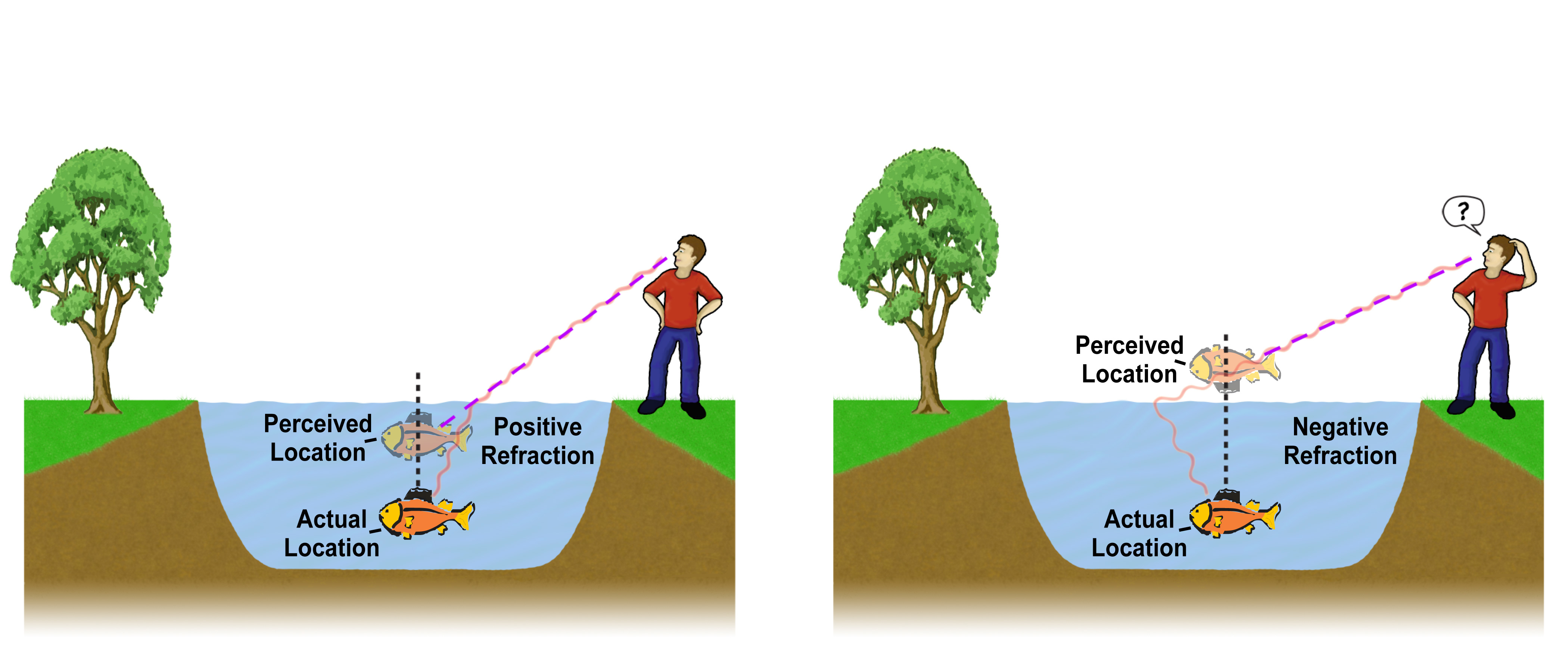
1. A swimming pool seems much shallower than it actually is; a spoon appears bent when part of it is in water and a boy's legs look shorter when immersed in pool. All these effects are due to the refraction of light.

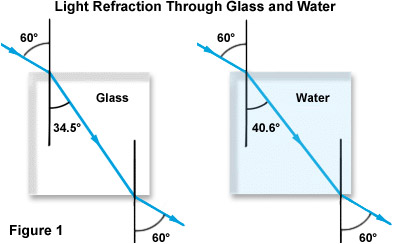
2. When a ray propagates from one medium to an optically dense medium, the ray refracts towards the normal. Conversely, a ray propagating from one medium to an optically less dense medium is refracted away from the normal.

3. The speed of light decreases as it propagates in the glass block, causing it to alter the direction of propagation. Since the incident ray and the refracted ray are from the same source, the frequency remains the same. Hence, the wavelength of the ray in the glass is shorter than the ray in the air.


Source: http://micro.magnet.fsu.edu/optics/lightandcolor/images/refractionfigure1.jpg

Refraction of Sound waves

1. The sound of a moving train at a distance is clearer at night than that in the day time. This is due to the effects of the refraction of sound waves.

2. At night-time, the layers of air close to the ground are cooler than the layers further from the ground.

3. Sound travels at a slower speed in cold air. As a result, the sound waves are refracted in the path of a curve (due to total internal reflection) towards the ground instead of disappearing into the upper layers of the air.
Read More »

Meaning And Definition Of Waves

Waves

Understanding Waves

Wave and Energy


A Wave is a disturbance that transfers energy between 2 points through vibrations (or oscillations) in a medium, without transferring matter between the two points.

Example 1: When you hold the end of a rope and a friend of yours wave the rope at the other end up and down, then a wavy movement appears. This is a movement of the rope and it transfers energy but NOT the rope.

Example 2: When you throw a stone on the surface of a calm pond, a circular ripple will appear and subsequently other smaller ripple will appear from the point of origin, these waves will eventually turn into a few big circles which then encompass  smaller circular ripples in the middle. What happen is, the kinetic energy from the stone is transferred to the water in the form of ripples, which is an example of wave.

There are two types of waves:

1. Transverse waves
2. Longitudinal waves

Transverse waves

Transverse wave is a wave in which direction of vibration is perpendicular to the direction of movement of wave.

Examples are : water waves, waves on a string, radio waves, light waves and electromagnetic waves.

Longitudinal waves

Longitudinal wave is a wave in which the direction of vibration is parallel to the direction of travel of the wave

Examples are: sound waves and waves on a slinky spring.(which consists of regions of rarefaction and compression).

Wavefronts


Wavefront is a line that joins all the points vibrating in phase, such as a line passing through similar wave crests. It consists of crest and trough. Crest is the peaky part of the wave and trough is the lowest part of the wave.

Wavefront is perpendicular to the direction of wave movement.

Oscillating System:

Waves are produced by oscillating systems (or vibrations) in a medium.

An oscillation is a to and fro movement along a fixed path.

Examples are: Swinging pendulum(horizontally) and a Spring swinging up and down (vertically).

What u must now is that:

One complete oscillation is a to and fro movement of a body when it has returned to its original position and is moving in the same original direction.

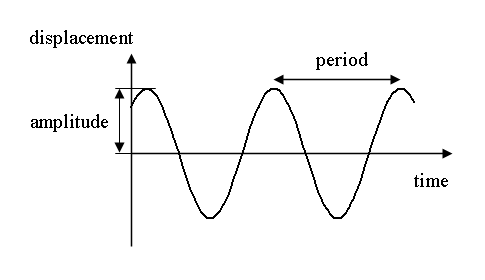
Amplitude, a, is the maximum displacement from the resting position.

Period, T, is the time taken to make one complete oscillation.

Frequency, f, is the number of oscillations produced in one second.
Read More »

Reflection of Light on a Curved Surface: Method to draw ray diagrams

1. There are two main types of curved mirrors, namely:

(a) Convex Mirror
(b) Concave Mirror

2. On a Concave mirror, the rays that are parallel and close to the main axis (small opening) converge to a point F (main or principal focus) and the distance FP is known as the focal distance of the concave mirror. (P is the surface of the mirror)


More notes can be found here:
http://www.glenbrook.k12.il.us/GBSSCI/PHYS/class/refln/u13l3d.html

3. On a Convex mirror, parallel rays that are close to the main axis, diverge from the surface of reflection. The rays are seen to diverge from a poinf F (main focus) behind the mirror. The distance FP is known as the focal length of the mirror.


 More notes can be found here:
http://www.glenbrook.k12.il.us/GBSSCI/PHYS/class/refln/u13l4a.html
Read More »

Relationship between Critical angle and Refractive Index and Application of Total Internal Reflection


Let’s say that the less dense medium is air (n=1).

Then the refractive index of the second medium is:

n = sin i /sin r

   = sin 90° / sin c

n =  1 / sin c

So,

REFRACTIVE INDEX :

n =  1 / sin c     or 1 divided by sin c

c = critical angle for the medium

Refractive Index, n, for some materials and their critical angles

Material Refractive       Index (n)        Critical angle (c)
Water                              1.33                  48.8°
Glass                               1.50                   41.8°
Diamond                         2.42                   24.4°

Example:

If the critical angle for a material is 42°. What is it’s refractive index?

n = 1 / sin c
   = 1 / sin 42°
   = 1.49

What do you think the material is?

Yes, the refractive index is 1.49 nearing to 1.50 therefore from the table above, the material is most probably glass.

Phenomena of Total Internal reflection


Diamonds
  • Brilliant diamonds have a high index of refraction.
  • Light entering a cleaved, or cut, diamond from the top may also eventually exit the top.
  • This gives a false notion of internal sparkle.
  • Colored flashes of light occur in a fiery diamond when light is separated into colors.

Rainbow formation

When sunlight shines on raindrops, refraction and total internal reflection occur in the raindrop.
When an observer receives the refracted light from the rainbows at specific angle, a vision of rainbow is formed.

Mirage

A mirage occurs when an object appears displaced from its true position.

Atmospheric mirages are created when light is bent, or refracted, as it travels through layers of air with differing densities.

Changes in air density are usually caused by changes in air temperature.

If the air near the ground is much warmer than the air above, light from the sky will bend up towards an observer’s eyes so that an observer looking down at the distant ground sees light from the sky.

The image of sky is shown as the mirage of a watery pavement, or water resting on hot desert sand.

When the light from an object is bent, making the object appear higher than it actually is, a superior mirage occurs.

When an object appears lower than it actually is, the mirage is called an inferior mirage.

Application of Total Internal Reflection

Fibre Optics

Fiber-Optics make use of total internal reflection to guide light along transparent fibres.

A strand of fiber-optic cable reflects the light that passes through it back into the fiber, so light cannot escape the strand.

Fiber-optic cables carry more information than conventional cable.

USES:

Communication – used in internet and telephone cables, t v cables.

Other uses –
Transmission of light to places which is difficult to illuminate e.g. dentist’s drill.
Endoscope – used to see internal organs of the body.

Binoculars
Binoculars are used to see distant objects.

There are two prisms arranged specially in each half of the binoculars.

Light rays from distant objects undergo total internal reflection in the prisms before entering the eyes of the observer.

The image seen by the observer is erect.

Example of Questions:

A glass block has a refractive index of n = 1.52. Calculate the critical angle c for this glass.

The critical angle for water is 49°.
Read More »

Understanding Total Internal Reflection of Light

1. If the angle of incidence is allowed to exceed the critical angle, it is found that light rays are not refracted. This is because all of the light rays are reflected back.

2.This phenomenon is called total internal reflection.

3. Total Internal Reflection occurs when:
   a. Light rays travel from a denser medium to a less dense medium.
   b. The angle of incidence is greater than the critical angle.

Light ray which travels from a denser medium to a less dense medium will be refracted away from the normal.

Here are some Q and A session:


Q: What happens when light passes from a transparent medium into air?

A: When light passes from a transparent medium into air, it bends away from the normal. It is refracted.


Q: Why the angle of refraction becomes 90° and not more? What do we call the angle of incidence at this limit?

A: This is the limit the light ray can be refracted in air because the angle in air cannot be larger than 90°. The angle of incidence in the denser medium at this limit is called the critical angle, c.


Q: What happens when the angle of incidence is more than the critical angle?

A: When the angle of incidence is greater than the critical angle, all the light undergoes reflection.

Later we will study the Relationship between Critical angle and Refractive Index
Read More »

Analysing Reflection of Waves

1. Reflection of waves occur when a wave strikes an obstacle. The wave undergoes a change in the direction of propagation or transmission when it is reflected.

2. The incident wave is the wave before it strikes the obstacles, whereas the reflected wave is the wave after it strikes the obstacle.


3. Reflection of waves can be explained the Laws of Reflection where:

i) The angle of incidence, i is equal to the angle of reflectance, r.

ii) The incident wave, the reflected wave and the normal lie in the same plane which is perpendicular to the reflecting surface at the point of incidence.


Applications of reflection of Waves in Daily Life

Safety

i) The rear view mirror and side mirror in a car are used to view cars behind and at the side while overtaking another car, making a left or right turn and parking the car. The mirrors reflect light waves from other cars and objects into the driver's eyes.

ii) The lamps of a car emit light waves with minimum dispersion. The light bulb is placed at the focal point of the parabolic reflector of the car lamp so that the reflected light waves are parallel to the principal axis of the reflector. Parallel light waves have a further coverage.

Defence

i) A periscope is an optical instrument. It can be constructed using two plane mirrors for viewing objects beyond obstacles. The light waves from an object which is incident on a plane mirror in the periscope are reflected twice before entering the eyes of the observer.

Telecommunications

i) Infrared waves from the remote control of an electrical equipment (television or radio) are reflected by objects in the surroundings and received by the television set or radio.
Read More »

Refraction of Light

Why do you think that part of a spoon that is immersed in water looks bent?


Many people think that as a stick/solid is put in liquid it becomes bent.

Do you think the same?

The reason why the spoon appears to be bent is due to the refraction of light or the bending of light. So we see spoon that appears bent in water or liquid, though in reality it is not.

What is REFRACTION OF LIGHT?

Refraction of light is a ‘bending of the light rays’ phenomena when light passes from one medium to another medium.

Refraction of light occurs when light passes through two transparent media having different densities. There are several consequences when light passes through mediums with different densities and direction.

Rays from Less Dense to Denser Medium

Q: What happens when a light ray passes through of a less dense medium into a denser medium?


A: Light rays will refract towards the normal when passing through a less dense medium into a denser medium, for example from air to glass.


Incidence Angle, Refracted Angle

The angle between the incident ray and the normal is named the angle of incidence, i.

The angle between the refracted ray and the normal is named the angle of refraction, r.


Denser to Less Dense medium

Q: What happens when a light ray passes through a denser medium into a less dense medium?

A: Light rays will refract away from the normal when passing through a denser medium into a less dense medium, for example, from glass to air.


Normal

Q: What happens when a light ray is directed to normal?
A: When light ray (incident ray) is pointed normally on a glass block, the refracted ray is unbent.


The Law of Refraction

The Law of Refraction states that:
(a) the incident ray, the refracted ray and the normal all lie in the same plane.
(b) the ratio of the angle of incidence to the angle of refraction for a given medium is fixed, that is sin i / sin r = constant.

The Law of Refraction is also known as Snell’s Law. (From dutch mathematician, Willebrord Snell)

Snell’s law states that for a light ray that passes from one transparent medium into another, the ratio of the sine of the angle of incidence to the sine of the angle of refraction is a constant.

The Law of Refraction is simplified as follows:
= sin i / sin r = n (a constant)

where
i = angle of incidence
r = angle of refraction
n = refractive index

A formula that is equivalent to Snell’s Law is     n1 sin i = n2 sin r
Where

n1 = refractive index of medium 1
n2 = refractive index of medium 2
i = angle of incidence
r = angle of refraction


The Refractive index

The refractive index is unitless

Here is shown the refractive index for a few materials:

Material            Refractive index
Vacuum            1.000
Air                    1.0003
Water               1.33
Ice                    1.31
Glass                1.53
Paraffin oil        1.40
Diamond          2.40

Refractive index n is defined as:
n = speed of light in medium 1 (vacuum or air) / speed of light in medium 2

Refractive index can also be represented by the following equation, Snell’s law:
n = sine of the angle of incidence, sin i /sine of the angle of refraction, sin r ( n = sin i / sin r)

Refractive index can also be determined by using:
n = Real depth, H /Apparent depth, h ( n = H/h)

Phenomena Due to Refraction of Light

The apparent Depth – A swimming Pool Looks Shallower than it Really is.

A Straight Object Placed in Water Looks Bent at the Surface (as discussed in the beginning).

Formation of Rainbow

Many more....
Read More »

Understanding the Reflection of Light: Law of Reflection of Light

1. The reflection of light can be studied by using light ray(s) and a plane of mirror which is placed on a piece of white paper.


2. When the ray of light is incident onto the surface of a plane mirror, the light ray does not pass through the mirror but is reflected back by the plane mirror.

3. The phenomena of ths experiment shows the phenomena of reflected light.

The Law of Reflection of Light States that:

1. The incident Ray, the reflected ray and the normal all lie in the same plane.

2. The angle of incidence is equal to the angle of reflection.


Image courtesy:
http://www.curriki.org/xwiki/bin/download/Coll_Athabasca/Unit3-Lesson2TheMovementofLight/reflection.jpg

More information at:

www.hsphys.com/ light_and_optics.html

Characteristics of Image that is formed on a plane mirror

1) It is upright
2) It is virtual
3) The distance form the object to the mirror is the same as the distance from the image to the mirror.
4) It is the same size as the object
5) It is laterally inverted


Read More »

Uses of Gas Laws

1.Bicycle Pump

When the piston is pushed into the cylinder, the air in the cylinder is compressed.

According to Boyle's Law, the air pressure inside the cylinder will increase.

This causes the air pressure in the cylinder to become higher than the pressure inside the tyre. Therefore, the air can flow into the tyre.

2. Hot-air balloon

When the air in a balloon is heated at atmospheric pressure, its temperature will increase.

According to Charles' Law, the volume of gas in the balloon will increase when its temperature increases.

Thus, the upward thrust on the balloon will increase when the volume of air displaced by the balloon increases.

Therefore, the balloon will climb upwards if the upward thrust exceeds the weight of the balloon.

3. Car Tyre

When a car is moving, the car tyre will experience frictional force and compression. This condition causes an increase in the temperature of the air inside the tyre.

According to the Pressure Law, the rise in the temperature  of air inside the tyre will cause the pressure inside the tyre to increase. Therefore, it is wise to pump the tyre just slightly below the recommended value in order to prevent over inflation and prevent bursting (though this rarely happens)
Read More »

Pressure Law

The Pressure Law can be clarified using the Kinetic Theory of Gases.

When gas is heated at a fixed volume, the gas molecules will move faster and with more energy.

The rate of collision of the gas molecules onto a unit area of the wall of the container will increase.

Each collision will also produce a greater force, because the change in momentum for each molecule increases when its speed is higher.

To maintain the same pressure in the container, the volume of the gas will increase so that the above effects will be balanced by the effect of an even smaller number of molecules per unit.

The Pressure Law states that:

For a fixed unit of mass and volume of a gas, the gas pressure is directly proportional to the absolute temperature of the gas.

P1/T1 = P2/T2

P1 = Initial Pressure
P2 = Final Pressure
T1 = Initial temperature in kelvin
T2 = Final temperature in Kelvin
Read More »

Boyle's Law

Boyle's Law can be explained by using the kinetic theory of gases.

When the volume of a gas in a container of gas molecules is reduced.

a) its density increased, that is, the number of gas molecules per unit volume increases.
b) the surface area of the container decreases.

The end result is that, the number of gas molecules which hit onto a surface area of the container per unit area also increases.

The increase in this rate of change of momentum in turn causes the pressure of the gas to increase.

If the volume of the container is otherwise increased:

a) density of the gas decreases, the number of gas molecules per unit volume increases.
b) the surface area of the container increases.

Therefore, the number of gas molecules hitting a unit surface area per unit time decreases.

The pressure is thus decreased.

BOYLE'S LAW states that for a fixed mass of gas at a fixed temperature, the pressure of the gas is inversely proportional to its volume.


According to Boyle's Law

P1V1 = P2V2
P1 = initial pressure
V1 = initial volume
P2 = final pressure
V2 = final volume

Read More »